Things have changed in the world. Dramatically. Exponentially. Radically. The world I knew in 1983, when I began working in Jewish ministry, has turned upside down. I have witnessed radical shifts in the Jewish community and in the church. Some of these changes are deeply troubling. Others, however, have opened unexpected and hopeful doors. Let me explain.
The Jewish Community Then (1983)
In the early 1980s, shortly after I became a believer in Jesus as Messiah, having been raised in a religious Jewish home, my faith was viewed as cult-like by most of the Jewish community. The prevailing belief was that I had been “brainwashed” by evangelical Christianity and had joined “the other team.” In their eyes, I had ceased to be Jewish.
The Jewish community, especially my parents, fought hard to bring me back. They wanted me to “wake up” from what they believed was a delusion and return to Judaism. From their perspective my faith in Jesus meant abandoning my people. I was a traitor and had accepted another religion.
The Church Then (1983)
The church of the early 1980s was also very different. Regardless of denomination, theology, or doctrine, there was a general knowledge of the unique place that Israel and the Jewish people hold in God’s heart and plan. Speaking in churches in 1983, there was a natural biblical “plumb line” to Israel and the Jewish people. The Jewish people and Israel were understood as special.
Even among those who differed theologically regarding Israel, there was still a deep sense that Israel mattered. The establishment of the modern State of Israel in 1948, whether seen as prophetic or not, was widely recognized as a significant, biblically inspired, moment.
The Church Today (2026)
Over the past two years, the church has changed dramatically and exponentially. The once understood biblical “plumb line” to Israel and the Jewish people is fraying. It is being seriously questioned. At best, it is slowly disappearing. At worst, for many, it is already gone. While writing this letter, I received a text from a woman in Florida who heard me speak at her church years ago:
“Hi Murray. I’m struggling with a topic and searching for answers. Shortly after October 7, I asked my pastor if we could take up a love offering for Israel. I also asked if we could invite a speaker—specifically you—to teach our congregation about Judaism and how we’re all connected through the gospel. He avoided both requests. I’ve since learned that many churches avoid the topic of Israel for political reasons. People are saying the modern State of Israel isn’t biblical Israel. Is that true? Do I still follow the biblical command to pray for Jerusalem and bless Israel?”
As I engage with people in the church, I sense a new and widespread confusion about Jews, Israel, and antisemitism. Many churches avoid the issues altogether.
Church demographics have also shifted. Many of those who cared deeply about Israel during the years when the “plumb line” was secure are now in their 70s and 80s. Younger generations are largely disconnected from Israel and the Jewish people. They are biblically illiterate regarding Israel’s role in God’s redemptive plan. Instead of learning from Scripture, many form their views through Instagram, TikTok, and YouTube- social media spaces saturated with misinformation.
The Jewish Community Today (2026)
The Jewish community once viewed Jewish believers in Jesus as renegades and apostates. That perception is changing. While disagreements remain, particularly concerning the messiahship of Jesus, the broader Jewish community increasingly recognizes us as Jews.
More than that, we are now fighting the same battle. Jewish people who do not believe in Jesus are reaching out to Jewish believers in Jesus for help in confronting antisemitism, supporting Israel, and engaging the Christian world.
Our ministry has been approached by rabbis and Jewish individuals from across the Jewish spectrum seeking partnership. Rather than being seen as adversaries, we are increasingly viewed as allies. Jewish believers in Jesus are becoming a bridge between the Jewish and Christian worlds.The Changes—and the Hope
This upside-down world is not likely to revert to what it once was. Unless the church actively opposes global antisemitism and teaches biblical truth about Israel and the Jewish people, the moment will pass. Some churches and individual believers will continue to stand with Israel. That matters.
After Hamas attacked Israel on October 7, 2023, instead of rallying against the evil of antisemitism, much of the church remained silent. Shockingly, some even turned against Israel. The train has left the station. But as it pulls away, we are still running after it, calling for it to slow down, stop, and turn around. There is always hope.
The Jewish community needs us now more than ever, and we are here to help. I don’t want to sound discouraged. God is at work. He is not finished. In fact, we are engaging with more Jewish people now than ever before. Not only do they need our help, they need our hope.
Here in Atlanta, we spend time intentionally in Jewish spaces and are always transparent about who we are. As we began the New Year I received 8 calls and emails from people who have Jewish friends and are sharing their faith. I was able to talk to several Jewish people at the Atlanta Gift Mart last month.
Mariah, our Community Outreach Coordinator, is working diligently in the Jewish community. She openly shares that she is a Christian working for Light of Messiah Ministries. She leads tours at the Breman Museum, teaching about the horrors of the Holocaust. By God’s grace, we met with the rabbi there. He knows who we are and what we believe, yet they are open to partnership. That openness is significant.
Mariah has also experienced deeply personal conversations...moments when Jewish people genuinely want to know why a non-Jewish woman cares so deeply about the Jewish people. While in Israel this past November, Mariah met a young man named Eli. She shared her lifelong love for the Jewish people. When he noticed a tattoo on her wrist, she explained that it symbolizes Jesus, the Passover Lamb, who gave His life for us. He listened. Before leaving, Eli saved her contact as: “Mariah Charnock – Righteous Gentile.”
Another meaningful moment came when Mariah spent time with her friend Edith, who asked about her trip to Israel. Mariah showed her a photo from the Mount of Olives and explained its significance. She shared Zechariah’s prophecy of the Messiah’s return in Zechariah 12:10.
Edith then asked, “Do you actually believe Jesus will return?” Mariah answered without hesitation that she does.
As she explained scripture, Edith listened closely and asked thoughtful questions. Please pray that the seeds planted will bear fruit.
Most recently, Mariah joined the planning committee for Atlanta’s Holocaust Memorial Day commemoration. After one meeting, a man named Tom asked why she cared so deeply. She shared how learning about the Holocaust shaped her heart. She explained how understanding that Jesus was Jewish, and that the Scriptures and early Church were Jewish, strengthened her faith. With tears in his eyes, Tom said something she will never forget:“What you are saying makes me feel like God hasn’t forgotten us.”
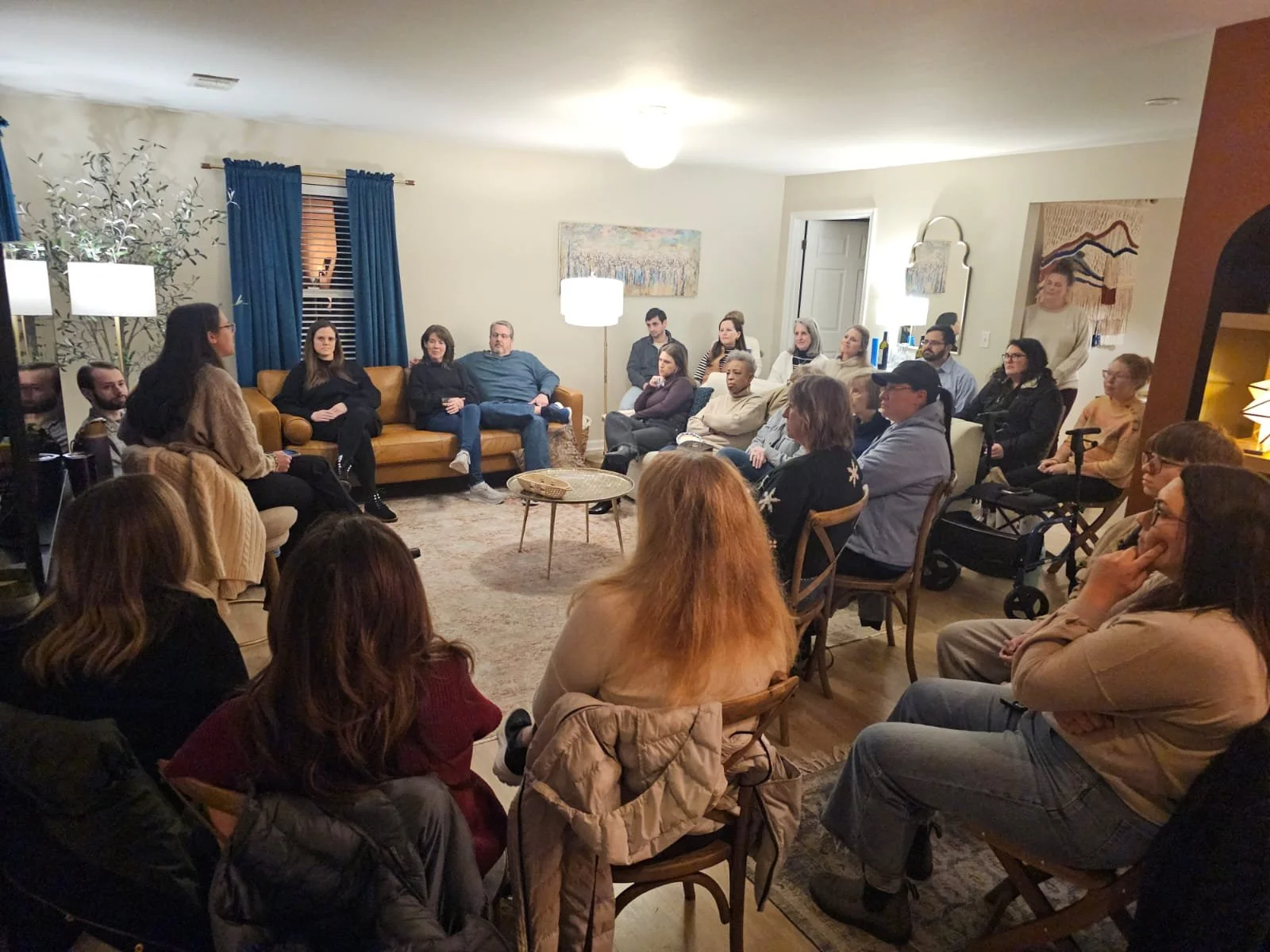
Stories like these are not accidental. They are the result of our faithful presence, intentional relationships, and our diligence to show up in spaces where trust must be earned. Our Shalom House is one such space. Below is a picture of a recent “Shalom House Stories” event.
As antisemitism rises globally and confusion grows within the church, the need for bridge-builders has never been greater. Jewish people are asking questions. Churches are seeking guidance. Conversations that once seemed impossible are now happening because we are standing in the gap to listen, love, and speak truth with humility.
Your prayers and partnership make our work possible. It allows us to be present in Jewish spaces, to educate churches, to confront antisemitism, and to offer hope rooted in Scripture and Messiah. It enables us to train, travel, teach, and respond when doors unexpectedly open, as they always do. Together, we can work to ensure that Jewish people are not alone and that the church is not silent.

By Murray Tilles
Founder and Executive Director